
Major Arcana · XIII
Death
Published
Ending · Release · Transformation · Transition
Death is a card of endings and transformation, not a prediction of physical death.
A role, pattern, relationship, or stage may have reached its natural limit. Holding it in place can take more energy than allowing the transition to happen.
An ending can carry grief even when it is necessary. Make room for that feeling and for the life that follows it.
At a glance
- Number
- XIII
- Arcana
- Major Arcana
- Upright
- Ending, transformation, release, necessary transition
- Reversed
- Resistance, stagnation, delayed ending, fear of change
- Yes or No
- Usually No
- Main message
- Let the completed chapter end so change has room to begin.
What Death means
When Death turns up, something may be changing in a way that cannot be fully reversed. The card asks you to recognize what is complete rather than keep negotiating with a chapter that has already ended.
Transformation is rarely as tidy as a before-and-after picture. There may be uncertainty between the old identity and the new one, along with practical details that need time to settle.
Release what no longer has a living role in your future. You can honor what mattered without requiring it to remain unchanged.
Symbolism
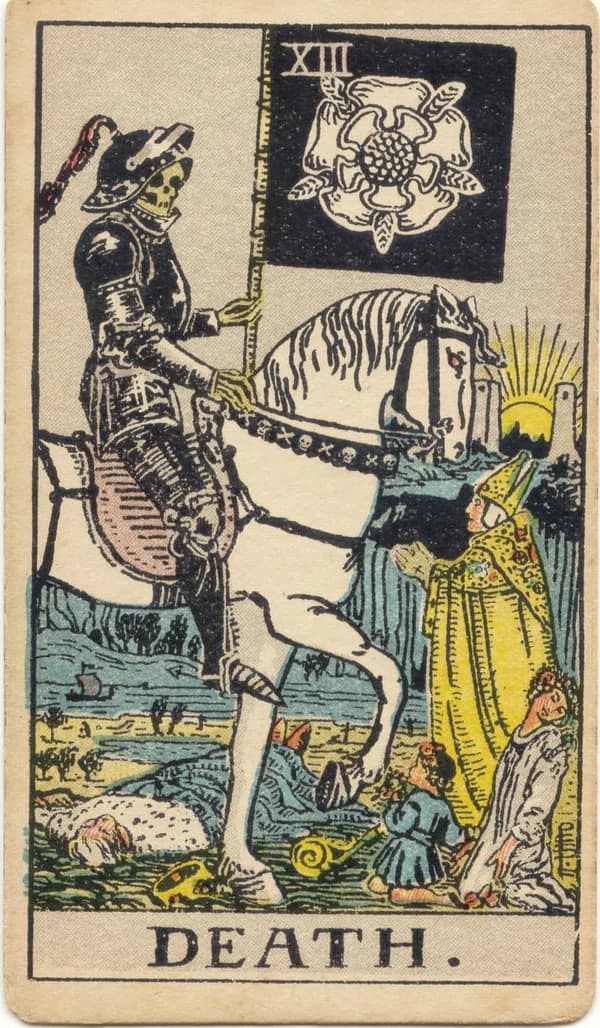
In the Rider-Waite-Smith card, a skeleton in dark armor rides a white horse through a scene where people of every rank encounter the same force of change. No title or status can make a life stage permanent.
The rider carries a black banner marked with a white rose. The dark field represents an ending, while the flower suggests purity, renewal, and life continuing in another form.
A rising sun appears between two towers in the distance. Its position makes renewal visible beyond the immediate loss, though the figures in the foreground may not yet be able to focus on it.
The river and boat recall passage from one condition to another. The card presents change as movement through a threshold rather than simple disappearance.
Upright meaning
Upright, Death points to a necessary ending, deep transition, or release that clears space for a different future. Accepting the change can help it move with less resistance.
This may involve leaving a job, changing a habit, redefining a relationship, or letting an old version of yourself become history. Do what the ending requires practically as well as emotionally.
Avoid rushing to call the loss a blessing. Transformation can be valuable and still deserve honest grief.
Reversed meaning
Reversed, Death often shows resistance to an ending that is already underway. Fear of uncertainty may keep you attached to a pattern whose purpose has passed.
It can also describe a transition that has stalled because one practical step remains undone. Identify the conversation, decision, or boundary that would make the ending real.
You do not need to welcome every change. You do need to decide how you will meet the change that is here.
Love and relationships
In a love reading, Death signals a major change in the form of a relationship. This can mean an ending, but it can also mark the end of an old dynamic within a bond that continues.
If you are single, a previous attachment or expectation may need to be released before a new connection has real space to develop.
In a relationship, be honest about what cannot continue as it has. Transformation requires participation from both people; one person cannot renew the partnership alone.
Death: yes or no?
Death is usually a no to continuing in the same form.
It may be a yes to ending, releasing, or making a decisive transformation. The old version of the plan is unlikely to remain unchanged.
Look beyond the immediate answer and ask what needs to conclude before a better option can emerge.
No to the old form. Let the transition begin.